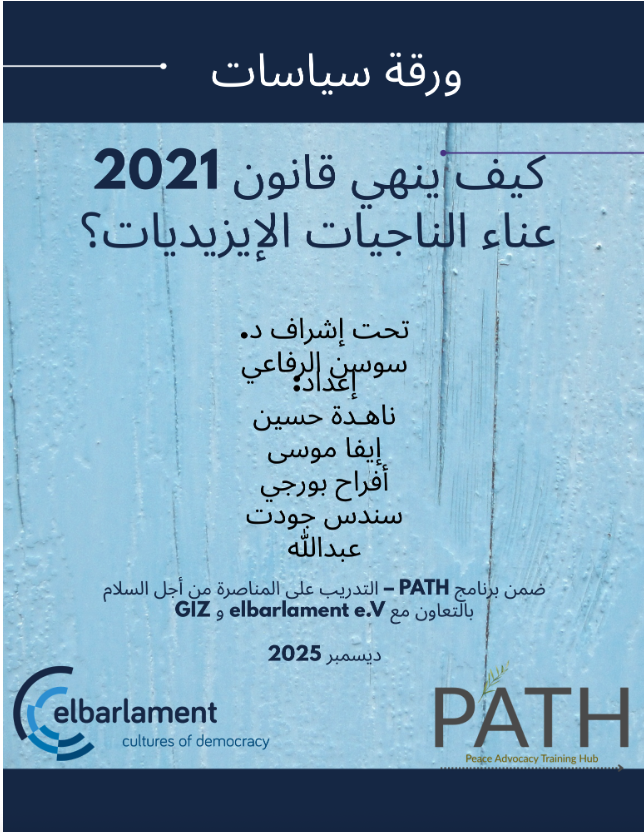
Authored by Nahida Hussein, Eva Mousa, Afrah Borji, and Sundus Jawdat Abdullah under the supervision of Dr. Sawsan Al Refai, the paper was developed in December 2025 within the framework of PATH (Peace Advocacy Training Hub), implemented by elbarlament e.V. in cooperation with Deutsche Gesellschaft für Internationale Zusammenarbeit (GIZ).
At a critical moment for justice and accountability in Iraq, this new policy paper enters the national and international debate on reparations and transitional justice following the genocide committed by the so-called Islamic State (ISIS) against the Yazidi community in August 2014. Published nearly five years after the adoption of Iraq’s Yazidi Survivors Law, the paper takes a bold and necessary step: moving beyond recognition toward real, survivor-centered implementation.
More than a policy analysis, this publication is the result of an intensive cross-border collaboration. Following a structured online training programme, the authors worked together over several weeks through joint discussions, collective drafting sessions, peer review, and guided methodological mentoring. Their work reflects not only rigorous research, but also regional solidarity and shared commitment to justice.
The paper critically examines the implementation of the Yazidi Survivors Law, exposing the persistent gap between its legal promises and survivors’ lived realities — particularly for those still residing in camps or in the diaspora. By combining legal analysis, institutional assessment, and comparative international perspectives, it offers concrete, practical recommendations to strengthen access to reparations and ensure that justice mechanisms are effective, coordinated, and sustainable. At its core, the paper asks a pressing question: how can formal recognition of genocide be transformed into tangible restoration of dignity and long-term reintegration?
This publication is available in Arabic only.
You can download it here.
————————————————————————————————————————–
About PATH – Peace Advocacy Training Hub
PATH was a five-month regional initiative (September 2025 – January 2026) dedicated to strengthening the leadership and advocacy capacities of 20 young women peacebuilders (ages 18–35) from Libya, Iraq, Syria, and Yemen. Designed in response to shrinking civic space and the persistent exclusion of women from political decision-making, PATH invested in the leadership of women who are already mediators, advocates, and community changemakers in their societies.
Through a structured Arabic-language online training programme, participants deepened their skills in leadership, peacebuilding, negotiation, advocacy, and digital communications. The programme combined technical learning with mentorship and peer exchange, connecting participants with regional experts in research, storytelling, creative media, and digital campaigning.
A core pillar of PATH was collaborative production: participants developed joint advocacy and storytelling initiatives that amplify women’s voices in peace and political reform processes. This policy paper is one such outcome — a concrete example of how regional learning, mentorship, and cross-border solidarity can translate into high-quality policy engagement.
Funded by Deutsche Gesellschaft für Internationale Zusammenarbeit (GIZ), PATH sought to help create a more favorable environment for women’s meaningful participation in peacebuilding and decision-making — ensuring that their perspectives help shape inclusive and sustainable futures.
This publication stands as both a policy contribution and a testament to the power of young women’s regional collaboration in advancing justice.