
- Country: Iraq, Yemen, Syria, Libya
- Contact person: Hanin Dabbagh, dabbagh@elbarlament.org
- Project duration: September 2025-January 2026
- Project objective: Strengthening the leadership and advocacy capacities of young women peacebuilders from Libya, Iraq, Syria, and Yemen.
PATH – Peace Advocacy Training Hub
PATH : Peace Advocacy Training Hub was a five-month project dedicated to strengthening the leadership and advocacy capacities of young women peacebuilders from Libya, Iraq, Syria, and Yemen.
Why this project?
Across these countries, women continue to play a vital yet under-recognised role in peacebuilding and democratic reform. Despite systemic barriers; ranging from political exclusion to shrinking civic space, women are mediators, advocates, and community leaders. PATH responds to these realities by investing in their leadership, skills, and regional solidarity.
What will PATH do?
Over the course of five months (September 2025 – January 2026), PATH:
- Delivered a structured online training programme in Arabic, combining leadership, peacebuilding, negotiation, advocacy, and digital communications.
- Facilitated mentoring and peer exchange with regional experts in research, storytelling, creative media, and digital campaigning.
- Supported participants in developing joint advocacy and storytelling initiatives to amplify women’s voices in peace and political reform processes.
The programme directly supported 20 young women leaders (ages 18–35) from the four target countries, while indirectly reaching their communities and networks engaged in peace and reform efforts.
PATH saught to create a more favourable environment for women’s meaningful participation in peacebuilding and decision-making, ensuring their perspectives shape sustainable, inclusive futures.
For seven weeks, participants explored key dimensions of peace, reform, and community resilience through a combination of expert-led sessions, peer learning, and practical tools.
Foundations of Peacebuilding and Inclusive Leadership
The journey began with Karma Ekmekji, who introduced the foundations of peacebuilding, conflict sensitivity, and women’s leadership. Participants reflected on how inclusive leadership and community participation are essential to building sustainable peace in their local contexts.
Democratic Reform and Policy Advocacy
In the second session, Dr. Maya Alrahabi led an exploration of democratic reform, constitution building, and feminist policy advocacy. The group discussed how gender-responsive legislation and participatory governance advance justice and equality across the region.
Digital Advocacy and Media Literacy
The third session, delivered by Ruwaida Al-Araby, focused on digital tools, misinformation, and gendered narratives. Participants practiced fact-checking techniques and examined how digital spaces can both undermine and support peacebuilding efforts.
Negotiation, Mediation, and Dialogue
For the fourth session, Sarah Al Sheikh guided the participants through negotiation, mediation, dialogue, and strategic communication. Using tools such as the Conflict Tree and Conflict Wheel, the group explored feminist and ethical approaches to addressing conflict.
Inclusive Governance, Social Cohesion, and Working with Local Leaders
Led by Lea Baroudi, the next session examined inclusive governance and social cohesion. Participants discussed the complementary roles of activists, mediators, and leaders, and explored whether advocacy and neutrality can coexist in peacebuilding work.
Together, they broadened the definition of inclusive governance to include groups often forgotten in political processes — unemployed youth, former fighters, detainees, stateless persons, and people without digital access. They identified community entry points for strengthening social cohesion and reflected on how exclusion fuels mistrust in the MENA region.
Transitional Justice and People-Centered Approaches
In the sixth session, Bissan Bunni guided participants through the principles of transitional justice. The group distinguished between justice (rights and rule of law) and transition (moving from conflict toward peace) and reflected on impunity, accountability, forgiveness, and institutional reform.
Drawing on national experiences, they discussed how transitional justice must be context-specific, inclusive, and participatory — ensuring that victims, women, and marginalized groups shape the process. The session emphasized how truth-seeking and reconciliation help rebuild trust and prevent renewed violence.
Designing Initiatives and Building Networks
The seventh session, led by Sarah Al Houni, focused on designing community-driven initiatives and building strong networks. Participants learned how to identify community needs, define target groups, set SMART goals, and design sustainable interventions.
Through examples from Kenya, South Africa, Somalia, Tunisia, and Lebanon, they reflected on the importance of adaptability when responding to emerging challenges. The session concluded with an exploration of network-building using tools such as the influence–interest grid, highlighting how strategic partnerships and trust are essential for long-term impact.
Power, Risk, and Resilience in Peacebuilding
Led by Alaa Assani, this session explored how women peacebuilders navigate power and risk in complex environments. Participants reflected on lived experiences and discussed strategies for sustaining leadership, including self-care, collective support, and intentional decisions around safety and visibility. The session underscored that while women are central to peace efforts, they often face heightened risks — making resilience, both individual and collective, essential for lasting impact.
Strengthening Peacebuilding Through Monitoring, Evaluation, and Learning (MEL)
Facilitated by Sara Shahine, the final session focused on how Monitoring, Evaluation, and Learning (MEL) strengthens the effectiveness, accountability, and inclusivity of peacebuilding initiatives. Participants explored how to design SMART, gender-responsive indicators and connect activities to long-term impact. Emphasis was placed on participatory approaches that promote continuous learning, equitable outcomes, and more informed decision-making.
Designed for women peacebuilders and advocates, this phase supported participants in transforming their knowledge, skills, and lived experience into concrete, real-world advocacy initiatives. It bridged theory and practice, helping participants move from ideas to impact.
Working in small teams alongside experienced mentors, participants developed practical advocacy outputs tailored to real audiences and local contexts. Through hands-on guidance, peer exchange, and collaborative learning, the mentorship phase strengthened strategic communication, credibility, and adaptability — essential skills for driving change in complex and often challenging environments.
Recognizing that meaningful change requires multiple approaches, the mentorship phase was structured around four complementary advocacy tracks, allowing participants to engage with the tools and methods best suited to their goals and contexts.
Mentorship Track: Research & Policy Advocacy
This track focuses on engaging formal decision-making spaces.
Participants learned how to translate lived experiences and local realities into clear, evidence-based research briefs and policy recommendations. Emphasis was placed on credibility, policy framing, and communicating in ways that resonate with institutions, donors, and policymakers.
This track was particularly valuable in contexts where data, evidence, and policy alignment are essential for achieving tangible impact.
Mentorship Track: Journalism & Storytelling
Storytelling is a powerful tool for change.
This track explored how narrative can shape public discourse and challenge dominant narratives. Participants worked with journalistic and storytelling formats to humanize social and political issues, making them more accessible and compelling. Here is the outcome of this track.
By centering marginalized voices and lived experiences, story-driven advocacy helps shift public opinion, build empathy, and generate pressure for meaningful change.
Mentorship Track: Artistic & Visual Storytelling
Creative advocacy opens new pathways for expression.
This track introduced artistic and visual storytelling as inclusive and innovative ways to communicate advocacy messages. Participants explored tools such as photo essays and graphic storytelling to reach audiences beyond traditional policy and media spaces.
Artistic approaches are especially valuable in restricted or sensitive environments, where creative expression can offer safer, emotionally resonant, and impactful forms of engagement.
Mentorship Track: Digital Campaigning & Strategic Communications
Digital advocacy helps messages travel further.
This track focused on amplifying advocacy messages and sustaining engagement through digital tools and platforms. Participants learned how to design effective online campaigns, use social media strategically, and build momentum around key issues.
Digital campaigning plays a critical role in connecting local realities to regional and global conversations, expanding reach and mobilizing broader support for change.
At a critical moment for justice and accountability in Iraq, this policy paper enters the national and international debate on reparations and transitional justice following the genocide committed by the so-called Islamic State (ISIS) against the Yazidi community in August 2014. Published nearly five years after the adoption of Iraq’s Yazidi Survivors Law, the paper takes a bold and necessary step: moving beyond recognition toward real, survivor-centered implementation. It is available in Arabic only.
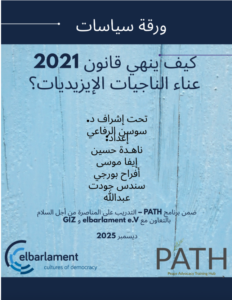
As part of the Journalism & Storytelling track, participants explored how narrative can shape public discourse and challenge dominant narratives. They worked with journalistic and storytelling formats to humanize social and political issues, making them more accessible and compelling. By centering marginalized voices and lived experiences, story-driven advocacy helps shift public opinion, build empathy, and generate pressure for meaningful change. Click on this image to see the outcome of this track:
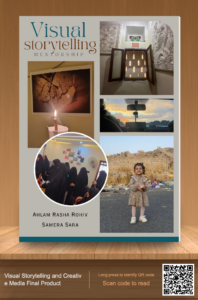
The project is funded by Deutsche Gesellschaft für Internationale Zusammenarbeit (GIZ) 